
Car Sick
Japan is great and I despair for the world
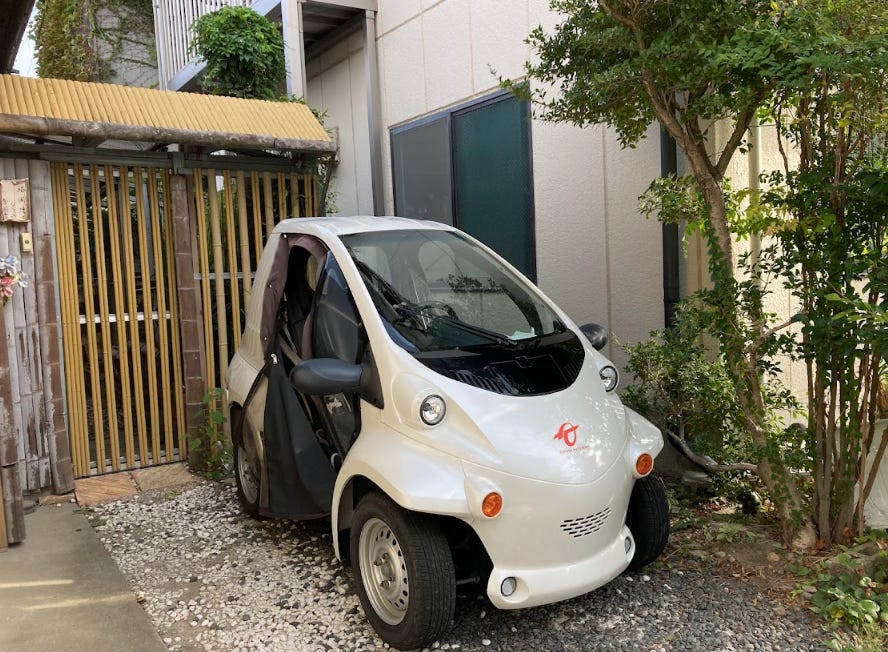
In travel the pictures fade away like flash images but the aftershock remains. It took me awhile to write this but I don’t know when my peculiar sense of dislocation will fade, so I will get this out of my system.
I flew to Japan for a spontaneous tasting trip. Not my usual mode of adventure – I prefer a more stationary immersion – but I wanted to feel out the place and get a sense for what all the fuss is about. So I wandered about, with every day a mini epic adventure, as wildly different in taste and texture as the rainbow nibblies on my breakfast platter. I landed in Osaka, spent several days in a hardcore Zen training monastery (Toshoji), went on a dazzling bike ride (Shimanami Kaido), and explored Hiroshima – a vibrant modern city seasoned with tragedy and hope. I poked about the ancient capitals of Kyoto and Nara, rising at 5am to beat the tourist hordes to the temples. I hiked the ancient Yamanobe no Michi road and the Old Nakasendo mountain trail through persimmon groves and restored mediaeval villages. I got attacked by a rogue toilet. I stayed my final night in Japan in a traditional ryokan atop a mountain in Ikoma, with a private onsen and a pair of diapered poodles. It was all good, all rich, and everyone I met was genuinely kind. I got lost inevitably but always got found — and to my surprise, I was never lonely. Never have I felt so deeply free.
From fishing villages to big cities to rural towns, I found one constant: the streets are just so nice. One block from any main artery the street is peaceful, pretty, and safe. Potted plants sit by doorways. Brooms and buckets, clean and stacked. In the back alleys shining copper pots sit out to dry on racks behind restaurants, unmonitored. Cobbled streets with shaded arcades. All this careful order clearly visible rather than obstructed by a wall of parked metal cubes. Children walking hand-in-hand to school, waiting patiently for the light to change. And bicycles, bicycles, bicycles, everywhere … transporting old people in linen smocks, students in knee socks, Yamato delivery bikes, parents with babies, monks in koromos, doctors in white coats. Bikes with umbrellas affixed to the handlebars to repel rain and sun. Every kind of bike. No special clothing, just practical transportation. Everywhere, the whirr of bicycles, and the chimes of arriving trains.
I did not hear a car honk in three solid weeks.
Extended street parking for cars is rare throughout the country. Of course, the cities and towns are old, most pre-dating car traffic – so streets are often narrow and winding, and there are places where cars just can’t go. But it is more than that. Even on wider streets residents might have small carports or driveways where they can keep their (tiny) cars but mostly, private vehicles are parked in shared lots and it is costly to rent space in them. In the cities you can’t even buy a car until you provide proof that you have a space to park it. Insurance costs are keyed to the size and power (thus: danger) of the vehicle. All major freeways are tolled. Car ownership is a privilege – and a responsibility – not a right.
For a matrix of reasons religious and historical and geographic, the Japanese ethos remains deeply collective. Public space is public; it is a collective asset and responsibility. People sweep the streets, tend the parks, repair the fences, voluntarily – because, this isn’t yours our mine, it is ours. The distinction between yours and mine, between me and you, is blurry. It is considered very rude to eat messily or talk on the phone on the street lest we disturb the experience of others (which had me ducking between buildings to eat a sandwich or FaceTime my brother). Caring for each other is caring for ourselves. Maintaining the commons is second nature. The idea of storing private property in public space is ridiculous.
I visited giant Buddhas and temples and historic sites, but it was this enacted sense of interconnection which showed me how Japan is the seat of Zen practice: of practice-realization.
I confess to seeing through the rose-coloured lenses of a tourist on holiday, and I am wary of romanticizing any culture. I certainly don’t have the depth of experience to analyze Japanese society. I do know that the collective mindset has its downsides – it’s not all cherry blossoms and Hello Kitty in a society forged by millennia of patriarchy and a deep tradition of conformity. At the same time, Japan has embraced globalism for decades and in some ways outstripped the West in consumer culture and style. My observations are superficial but in terms of car culture I witnessed a different world, and it is a better one.
I want to say I came home inspired, but actually I feel kind of hopeless right now. Sure, we are building bike lanes and pedestrian plazas and trying to revive commuter rail. In Japan buses and trains are frequent and they go everywhere, and that makes a big difference, but technology won’t save us, nor infrastructure. What is significant is what I did not see: I did not see one F150 or Silverado or Cybertruck in my three weeks in Japan. Massive vehicles which have little purpose for moving goods, but are merely fashion accessories to prop up fragile egos. They leach health and time and money and land and resources from all of us. We are such babies crying me! me! me! look at ME! Our entire increasingly-globalized economy is rushing to fill that bottomless spiritual void.
My good friend Chris has lived in Japan for 35 years. He told me that in Japan, standing out is not always a good thing. He said, making others jealous is avoided. Can you imagine?! We are so insecure, we live to make our neighbours jealous. Our insecurities are fuelled by social media. Our streets reek of gasoline and self-loathing. I want to be hopeful but at this moment I don’t see how we’re gonna get out of this alive.
So yeah, sorry. I had a great trip to Japan. Go, if you can, as soon as you can. Airfares are cheap. The food is great. And it is so very easy to get around.


Photos
Top: a tiny car in a tiny driveway
Gallery: Left to Right, top to bottom:
•Biking on Ikujishima Island
•Back streets of Nara
•Onomiyaki on the grill in a karaoke bar
•Hiroshima, and the Atomic Bomb Dome. I could live here.
•Breakfast at a ryokan in Sakurai (cost: CDN $10 including takeaway box for lunch)
•Street corner in Kyoto
•Hostel on an arcade street in Onomichi
•View over Onomichi (super sweet town)
•selfie with Hoitsu Suzuki at Toshoji monastery
This was a good read and timely as I'm finally going to Japan next year. I haven't traveled much but in the trips I have done I've used a bike to see the place, and I wouldn't have it any other way. I hope I can do this with my short time in Tokyo and will definitely happen in Vietnam. I'm craving a break from the F150 community vibes so much. Ugh.
Wow. Lovely to ready will I am on the other end of the world, a small community on the Amazon river. No cars here at all! Or anything except boats. I especially like what you write about collectivity and community. Everywhere I have been from Mexico south that is the story. And the survival strategy.